






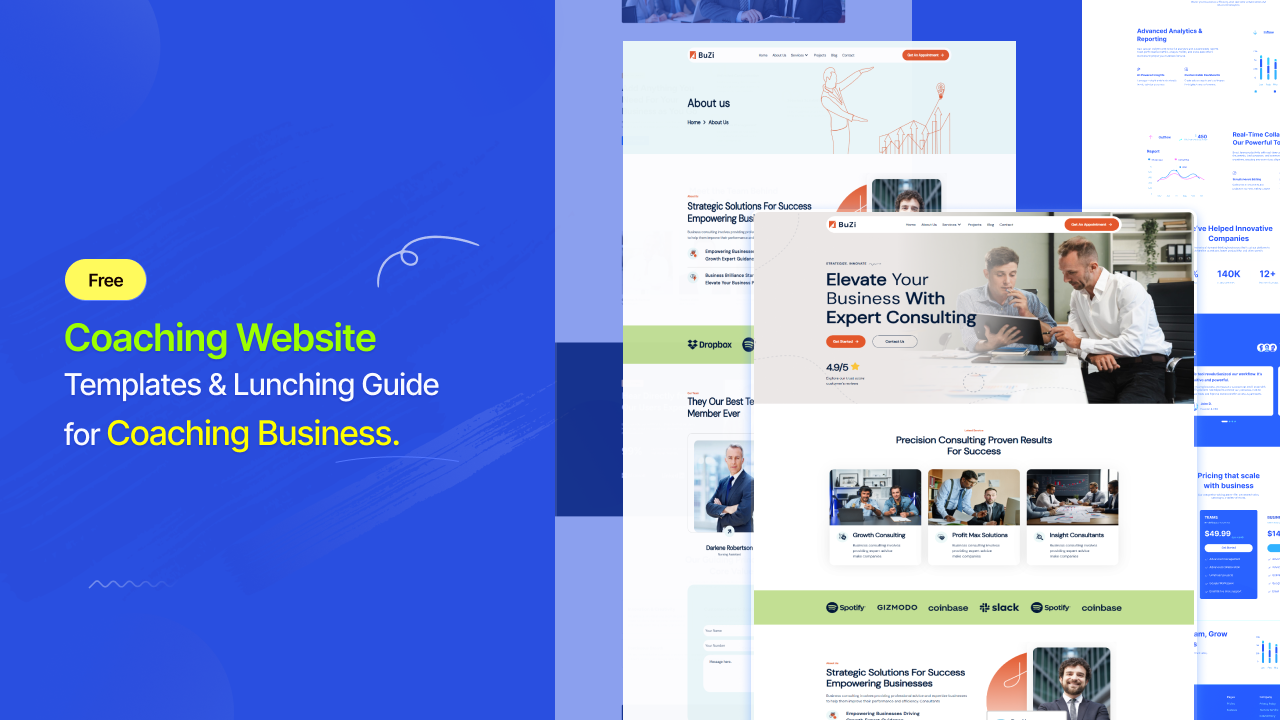

Your Coaching Skills Deserve a Website That Matches
You’ve put in the hours. You’ve earned the credentials. You know how to change someone’s life inside a 60-minute session.
But your website? It looks like it was built in a hurry on a Sunday afternoon — and your potential clients can tell.
Here’s the uncomfortable truth: your website is your first coaching session with every new visitor. Before they read a single word of your bio, they’ve already decided whether you’re worth trusting. That judgment happens in 50 milliseconds — roughly the time it takes to blink.
The coaching industry hit $5.34 billion in global revenuein 2025 and is projected to reach $5.8 billion in 2026.
(Source: ICF Global Coaching Study, via luisazhou.com)
Competition is fierce. But here’s the good news: the right coaching website template closes the credibility gap instantly — and you don’t need to hire a designer or write a single line of code to get it done.
Let’s break it all down.
📌 Key Stat: 85% of coaching clients report a boost in self-confidence after working with a coach — but first, they have to find you, trust your site, and book a session. (Source: ICF Global Coaching Study, via entrepreneurshq.com)
What Is a Coaching Website Template?
A coaching website template is a pre-designed, professionally structured website layout built specifically for coaches — life coaches, business coaches, executive coaches, fitness coaches, career coaches, and more.
Think of it as a blueprint your client handed you before a session began. The structure is already set. The flow is already tested. All you do is fill it with your story, your services, and your personality.
A great coaching template handles:
- A compelling homepage hero with a clear offer
- About page that builds personal connection
- Services or programs page with pricing or inquiry CTAs
- Testimonials section for social proof
- Blog or resources for SEO and thought leadership
- Contact or booking page with scheduling integration
What separates a coaching template from a generic website template is intent. Coaching templates are built around personal trust. The visitor isn’t buying a product — they’re choosing a person to help them change. Every design decision serves that emotional journey.

Why Your Coaching Website Is a Business Decision, Not Just a Design Choice
Coaches who downplay their website tend to say the same thing: “My clients come through referrals.”
That works — until it doesn’t.
Here’s what the data says:
|
Stat |
Source |
|
Visitors form a site opinion in 50ms |
CXL, Missouri University of Science & Technology |
|
94% of first impressions are design-related |
CXL |
|
75% of users judge credibility by website design |
Stanford Web Credibility Research |
|
88% of users won’t return after a bad experience |
Turbopress.pro |
|
70% of individuals report improved performance after coaching |
ICF |
|
85% of coachees report increased self-confidence |
ICF |
The moment a potential client Googles “life coach near me” or “business coach for entrepreneurs,” they’re not just evaluating you — they’re evaluating your site. If it doesn’t communicate warmth, expertise, and professionalism within the first scroll, they’re gone. Off to your competitor who just happened to choose a better template.
Your website isn’t a vanity project. It’s your highest-leverage marketing asset.
Types of Coaching Website Templates You Should Know
Not all coaching websites look the same — nor should they. Here’s a breakdown of the main types you’ll encounter:
🌿 Life Coaching Website Templates
The most popular category. Life coach templates lean into warmth, personal story, and transformation. Expect:
- Soft color palettes (earth tones, pastels, warm whites)
- Large personal photography above the fold
- Testimonial-heavy layouts
- “Book a Free Discovery Call” as the primary CTA
Best for: Personal development coaches, mindset coaches, relationship coaches, women’s coaches.
💼 Business Coaching Website Templates
These carry a more structured, corporate-adjacent energy — without going cold. Business coaching templates highlight ROI, frameworks, and results.
- Bold typography and high-contrast layouts
- Case study or client result sections
- Speaking, consulting, and program tier pages
- Professional headshot above fold with authority-driven copy
Best for: Executive coaches, entrepreneurship coaches, leadership coaches, startup advisors.
🧠 Career Coaching Website Templates
Clarity is the brand of career coaching — your template should reflect it. These designs are typically clean and structured with strong navigation.
- Resume and skill-building service pages
- Before/after client transformation stories
- LinkedIn integration and credentialing sections
- Workshop or group program pages
Best for: Career transition coaches, job search coaches, HR consultants.
🏋️ Health & Wellness Coaching Website Templates
Energy, movement, and vitality — that’s the visual language here. Expect:
- Bold photography or video backgrounds
- Nutrition or fitness program breakdowns
- Habit tracking or app integrations
- Community or membership section
Best for: Fitness coaches, nutritionists, health coaches, wellness practitioners.

What Every Great Coaching Website Template Must Include
Whether you’re building a life coach website or a consulting site, these are the non-negotiables:
1. A Personal Hero Section That Leads With Transformation
Your headline shouldn’t start with “Welcome to my website.” It should speak directly to where your client is right now and where you’re taking them.
Example: “You don’t need more motivation. You need a strategy.”
Templates that leave room for this kind of bold, personal messaging outperform generic ones every time.
2. A Clear and Singular Call-to-Action
What do you want the visitor to do? Book a discovery call. Sign up for a workshop. Download a guide. Pick one and design around it. The best coaching templates make the CTA unmissable — placed strategically in the hero, after the about section, and at the bottom of every page.
3. Social Proof That Tells a Story
Client logos are for B2B companies. Coaches need human testimonials — the kind that describe a life before and after coaching. Your template should have a testimonials section built in, ideally near the top of the homepage, not buried at the bottom.
4. An About Page Built for Connection
Clients choose coaches they trust. They want to know your story, your philosophy, and why you care. A great coaching template gives the About page room to breathe — not just a two-line bio and a headshot.
5. Mobile-First Responsiveness
Over 60% of global web traffic now comes from mobile devices. (Source: Loopex Digital, 2026) Your coaching template must look and function flawlessly on a phone screen. Pinch-zoom is a client lost.
6. SEO-Friendly Page Structure
Every coaching template should come with proper heading hierarchy (H1, H2, H3), fast loading speed, and clean code. These aren’t bonus features — they’re baseline requirements for ranking on Google.
Coaching Website Templates: Free vs. Paid — What’s the Smarter Move?
This is where most coaches get stuck. Let’s make it simple.
|
Feature |
Generic Free Templates |
Premium Paid Templates |
Free Premium (aBlocks) |
|
Coaching-specific layouts |
Rarely |
Usually |
Yes |
|
Professional design quality |
Variable |
High |
High |
|
Full customization |
Limited |
Yes |
Yes |
|
No-code editing |
Sometimes |
Usually |
Yes |
|
Mobile optimization |
Inconsistent |
Yes |
Yes |
|
Ongoing updates |
Rarely |
Often |
Yes |
|
Cost |
$0 |
$30–$300+ |
$0 |
Here’s the thing people don’t tell you: “free” doesn’t have to mean a compromised design. The right platform gives you premium-quality coaching templates at zero cost — and lets you customize everything without touching a line of code.
That’s exactly what template kits delivers.
The Best Free Coaching Website Templates in 2026: Template-Kits.com

If you’ve been scrolling Squarespace, Wix, or ThemeForest wondering why you have to pay $80 for a template that still needs hours of tweaking — stop.
Template-kits.com is a library of professionally designed, fully customizable website templates built on aBlocks — a WordPress Gutenberg-based page builder. And every single template is completely free.
Not a trial. Not “free with limitations.” Completely free.
Here’s why it matters for coaches specifically:
🎨 Designed by Real Designers, Not Algorithms
Every template in the library is built by professional designers who understand how visual hierarchy, color psychology, and layout flow affect trust. These aren’t cookie-cutter grids with placeholder text. They’re polished, considered, and conversion-aware.
As one real user put it:
“aBlocks has completely changed how I see Gutenberg. The customization options are incredibly intuitive, and everything feels polished and professional. It’s like Gutenberg finally found its missing piece.” (Source: template-kits.com user testimonials)
⚡ One-Click Import. Total Creative Control.
The workflow is clean and fast:
- Visit template-kits.com and browse the library
- Install and activate the free aBlocks WordPress plugin
- Import your chosen template in a single click
- Customize every block — colors, fonts, images, text, layout — without code
- Hit publish
From browsing to live site: hours, not weeks.
🔧 Works With Any WordPress Theme
Whether you’re on a classic theme or a modern block theme, aBlocks templates integrate cleanly. No theme lock-in. No proprietary ecosystem to escape later.
🔄 New Templates Added Regularly
The library grows continuously. Coaching, consulting, education, wellness, business — fresh designs across every niche, built to reflect modern design standards.

How to Create a Coaching Website: Step-by-Step
If you’re starting from scratch, here’s the fastest, smartest path from zero to published:
Step 1: Define your niche and ideal client. Life coach for burnt-out executives? Career coach for recent graduates? The sharper your focus, the better your copy — and the better your template choice.
Step 2: Choose your platform. For no-code, flexible, SEO-friendly coaching sites — WordPress + aBlocks via template-kits.com is hard to beat. It’s free, fast, and fully owned by you (no monthly platform fees beyond hosting).
Step 3: Import and customize a coaching template. Pick a layout that fits your brand’s energy. Swap colors and fonts to match your visual identity. Replace placeholder images with real photos of yourself — clients want to see the human behind the coaching.
Step 4: Write copy that speaks to transformation. Don’t describe what you do. Describe what changes for your client. “I help ambitious women reclaim their confidence” converts better than “I offer life coaching services.”
Step 5: Set up your booking flow. Use scheduling tools like Calendly, Acuity, or TidyCal. Embed them directly into your template’s CTA buttons. Friction kills conversions — make booking effortless.
Step 6: Add social proof early. Even two or three strong testimonials — positioned above the fold or immediately after your hero section — significantly improve trust and conversion.
Step 7: Optimize and publish. Check mobile view, confirm page speed, write your meta title and description, and hit publish.
💡 Pro Tip: Add your own face to the hero section above the fold. Coaching sites with personal photography in the hero section consistently outperform those with stock images. Authenticity is your most powerful design element.
Coaching Website Design: What the Best Ones Have in Common
Looking at the highest-performing coaching websites in 2026, a few patterns show up repeatedly:
- The message is personal, not corporate. The best coaches write to one ideal client, not everyone.
- Social proof appears early. Client wins, testimonials, and press features are placed in the hero section or right below it — not buried in a tab called “reviews.”
- The CTA is singular and repeated. “Book a free discovery call” appears after the hero, after the about section, and in the footer. Visitors always know what to do next.
- The design reflects the coach’s energy. High-energy fitness coach? Bold palette, strong photography. Mindfulness coach? Soft tones, generous whitespace. Your template should match your vibe — not fight it.
- The About page is the real homepage. For coaches, the About page is often the highest-traffic page. Your template should make it easy to tell a compelling personal story there.
The Bottom Line: Your Template Is Your First Impression
In a coaching industry that’s growing at a near-double-digit annual rate and projected to reach $9.5 billion by 2032, the coaches who win clients online aren’t necessarily the most experienced or the most credentialed. They’re the ones who communicate trust, warmth, and expertise within the first few seconds of a website visit.
Your template determines whether that first impression works for you or against you.
You don’t need to spend thousands on a web designer. You don’t need to spend weeks learning code. You need a professionally designed, purpose-built coaching template — and you need to make it yours.
Template kits is where coaches go when they want premium design without the premium price tag. Free templates. Built by designers. Powered by aBlocks. Fully customizable on WordPress.
🚀 Ready to Launch Your Coaching Website?
Browse free professional coaching website templates at template-kits.com — import with one click, customize everything, and publish the site your coaching business deserves.
Your next client is already searching. Make sure they find something worth staying for.
Coaching Website Templates: Frequently Asked Questions
How do I create a coaching website?
Start with a purpose-built coaching template rather than a blank canvas. Install WordPress, activate the free aBlocks plugin, import a template from template-kits.com, then customize copy, colors, and images to match your brand. Add a booking tool and publish. Most coaches can launch in a weekend.
Are there free coaching website templates I can download?
Yes.Template-kits.com offers professionally designed, fully free templates powered by the aBlocks WordPress builder. Other sources like Colorlib, Wix, and Webflow offer limited free options, but the design quality varies significantly.
What’s the best life coach website template?
The best life coach template for you depends on your niche and visual identity. Look for a layout that centers personal photography, includes a prominent testimonials section, and has a clear discovery call CTA. Templates available at template-kits.com are built to these standards and are fully free.
Can I get coaching website templates in Word format?
Coaching website templates in Word format (DOCX) are typically used for coaching program worksheets or session outlines — not web design. For a live coaching website, you need a web-based template through platforms like WordPress, Wix, or Squarespace. For document-style coaching templates, platforms like Canva or Etsy offer downloadable options.
What should a business coaching website include?
A strong business coaching website needs: a clear value proposition for your ideal client, authority signals (credentials, press, client logos), a case study or result-focused testimonials section, service and pricing tiers, and a streamlined path to a discovery call or consultation booking.
What are the 5 C’s of coaching?
The 5 C’s of coaching are typically defined as: Clarity (understanding the goal), Commitment (dedication to the process), Confidence (belief in the outcome), Communication (honest dialogue), and Consistency (sustained effort). (I must fact-check — variations exist across coaching frameworks and organizations)
What is the 70/30 rule in coaching?
The 70/30 rule in coaching suggests that the client should do 70% of the talking in a session, while the coach speaks 30% of the time. The emphasis is on asking powerful questions that guide the client to their own insights rather than advising. (I must fact-check — this is a widely referenced concept but sourcing varies)
What are the 7 pillars of coaching?
The 7 pillars of coaching vary by framework but commonly include: Presence, Listening, Questioning, Feedback, Goal-Setting, Accountability, and Trust. Different coaching bodies (ICF, EMCC, etc.) define their competency models differently. (I must fact-check against the latest ICF Core Competencies model)