







Fifty years ago, a sharp suit and a confident handshake were your first impression. Today, it is your URL.
100% of home buyers now use the internet during their home search process, according to NAR — every single one. More than half (52%) of recent buyers found the home they ultimately purchased online, up from just 37% in 2010. And 70% of buyers used a mobile or tablet device during the process, according to NAR’s 2025 Profile of Home Buyers and Sellers.
If a seller Googles your name and finds a slow-loading brokerage profile page, a broken gallery, or no personal site at all, they do not call you. They call the agent whose website answered their question in under three seconds.
That is what a great real estate website template solves. Not a design problem. A revenue problem.

What Is a Real Estate Website Templates?
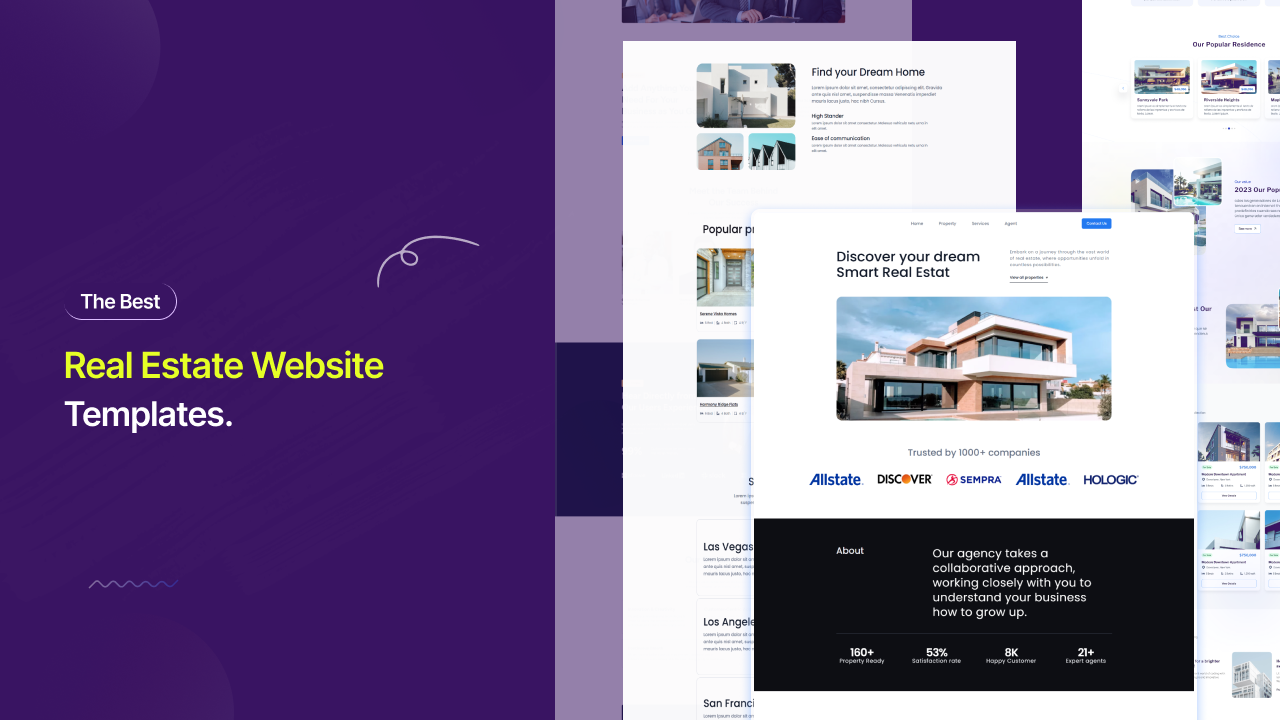
A real estate website template is a professionally pre-designed website layout built specifically for agents, brokers, property developers, and real estate agencies. It gives you the page architecture, section structure, and visual framework your clients expect — without requiring you to design anything from scratch or hire a development team.
The difference between a real estate template and a generic business template is structural, not cosmetic. Real estate templates are built around property display logic: filterable listing grids, map-based search, property detail pages, lead capture forms tied to specific listings, and agent profile sections that build personal trust. Every design choice serves the buyer or seller journey, not a generic conversion funnel.
A great real estate website template includes:
A search-first hero section with location, price, and property type filters visible immediately. Property listing pages with high-resolution galleries, virtual tour support, and mortgage calculator integrations. Agent or team profile pages with credentials, transaction history, and direct contact options. Neighborhood guide sections that double as SEO landing pages. A lead capture form tied to every property detail page — not buried on a contact tab.
Why Your Real Estate Website Template Matters More in 2026
The numbers from NAR make it clear this is not a trend — it is the baseline expectation of every buyer and seller in today’s market.
46% of buyers start their home search online as their very first step, and 85% rank real estate agents as the most useful information source — but only after doing their own online research first. They arrive at your website already informed, already comparing, and already forming opinions about your professionalism.
April 2026 saw 4.02 million existing home sales at a median price of $417,800, according to NAR’s latest data. The market is active. The competition among agents for digital visibility is intense.
|
Statistic |
Source |
|
100% of home buyers use the internet during home search |
|
|
52% of buyers found their purchased home online |
|
|
46% start the search online as their first step |
|
|
70% used mobile or tablet devices during the search |
|
|
88% of buyers purchased through an agent or broker |
|
|
53% of mobile users leave a page that takes over 3 seconds to load |
|
|
April 2026 median home sale price |
$417,800 — NAR |
The agents winning listings in 2026 are not necessarily the most experienced ones in the room. They are the ones with the sharpest digital presence — and the right template is where that presence starts.

What Every Great Real Estate Website Template Must Include
A Search Bar in the Hero Section
This is non-negotiable. The most important action a real estate website visitor wants to take — searching listings — must be the first thing they see. Templates that bury the search function below the fold, behind a menu, or on a separate page lose the visitor before they have a reason to stay. Your hero search should include at minimum: location field, property type selector, and price range.
IDX / MLS Integration Capability
MLS (Multiple Listing Service) data is the heartbeat of any real estate agent’s website. IDX (Internet Data Exchange) is the technology that connects your website to live MLS listings. On WordPress, real estate templates pair with IDX providers like IDX Broker, Realtyna, or RealTina to deliver a portal-style listing experience on your own domain — not Zillow’s.
Your template needs to be IDX-ready. That means it should have a dedicated listings page architecture, a property detail page template, and search filter logic that can receive live MLS data without clashing with the design. This is the single most technically important feature in any real estate website template — and most generic templates fail here entirely.
Property Listing Pages That Sell on Their Own
Every property in your template should have its own dedicated page — not just a thumbnail in a grid. A high-converting property detail page includes a full-resolution image gallery or virtual tour embed, property specifications (bedrooms, bathrooms, square footage, lot size), neighborhood highlights, a mortgage calculator, map integration, and a lead capture form specific to that listing.
Colorlib’s analysis of real estate template structures shows that templates with individual agent profiles alongside property detail pages outperform generic brokerage layouts because they maintain personal trust throughout the browsing experience. The buyer sees the property and the person selling it on the same page.
Neighborhood Guide Architecture
Neighborhood pages are a competitive SEO advantage that most real estate templates leave out — and most agents never think to build.
The best-performing real estate websites in 2026 create dedicated neighborhood pages with honest local overviews, pros and cons, median price data, school ratings, commute information, and embedded filtered listings. These pages become long-term SEO assets that rank for searches like “best neighborhoods in [city]” or “homes for sale near [school name]” — bringing in highly qualified organic traffic indefinitely.
Your template should include a neighborhood or area guide section as a standard page type, not an afterthought.
Lead Capture on Every Page
A real estate website generates leads through inquiry forms, showing requests, home valuation tools, and market report sign-ups. Your template needs to make lead capture seamless at every decision point — not just on a contact page. Research from Gola Supply’s analysis of real estate templates found that templates with built-in appointment scheduling see meaningfully higher inquiry rates than those relying on a single contact form.

Types of Real Estate Website Templates
Real Estate Agent Website Templates
Built for individual agents and small teams. These templates center personal branding — your photo, your specialty, your track record, your market. The hero section leads with you, not the listings.
A great agent template includes a prominent bio section with production stats (“$85M in closed volume since 2018”), a testimonials section positioned near the top of the homepage, a featured listings grid, a market area or neighborhood specialization section, and a simple direct contact form. The design communicates personal accountability — a specific person stands behind every transaction, not an anonymous brokerage.
Individual agent templates should feature a prominent bio and photo, property portfolio with active and sold listings, client testimonials, neighborhood expertise sections, and direct contact forms with scheduling options, according to Colorlib’s template research. The personal touch matters enormously in real estate — clients hire people, not businesses.
Luxury Real Estate Website Templates
Luxury templates operate under a completely different visual language: restraint, space, and cinematic quality. The design must communicate that the properties on this site are worth millions — and the agent selling them understands what that means.
Dark, editorial backgrounds with cream or gold typography. Full-screen video backgrounds on the homepage showing interiors at golden hour. Minimal navigation that keeps the focus entirely on the property. These are the design signatures of the best luxury real estate websites — sites like Sotheby’s, Jade Mills, and Douglas Elliman — and the templates that aspire to that tier reflect each of those choices.
Key features: video hero support, single-property showcase pages with immersive gallery layouts, virtual tour embedding, and an inquiry form that frames the process as an exclusive consultation, not a generic lead form.
Bootstrap Real Estate Website Templates
Bootstrap-based HTML templates are the developer’s starting point — clean, responsive, and built on the most widely used CSS framework in the web. Colorlib’s collection of Bootstrap real estate templates includes options like ESTATO, which offers 8 different home page variations, 8 property pages, 5 agent pages, Google Maps integration with custom property icons, and a built-in loan calculator.
These are best for developers who want to build a custom real estate platform from a solid foundation — or for agencies delivering bespoke agent sites that need to be maintainable without a proprietary builder.
Responsive Real Estate Website Templates (Free HTML/CSS)
Fully responsive HTML/CSS real estate templates are widely available for developers comfortable with code. They provide the layout structure, navigation patterns, and property display grids that real estate sites require — with no builder dependency and no monthly platform fee.
For non-developers, these require a front-end developer to customize and maintain. For developers, they are the most flexible and cost-efficient starting point.
Real Estate Website Templates: Platform Comparison
|
Platform |
Best For |
IDX Ready |
No-Code |
Free Templates |
Monthly Cost |
|
WordPress + aBlocks |
Agents, brokers, developers |
Via plugin (IDX Broker, Realtyna) |
Yes |
Yes — template-kits.com |
Hosting only |
|
WordPress + Elementor |
Agencies, custom builds |
Via plugin |
Yes |
Limited |
Hosting + plugin |
|
Squarespace |
Solo agents, boutique firms |
Limited |
Yes |
No |
$23–$65/month |
|
Webflow |
Design-forward agencies |
Via embed |
Partial |
Limited |
$14–$39/month |
|
Framer |
Modern luxury branding |
Via embed |
Partial |
Limited |
$10–$30/month |
|
Bootstrap HTML |
Developers |
Custom integration |
No |
Yes (Colorlib, etc.) |
$0 + hosting |
WordPress remains the most versatile platform for real estate websites that need genuine IDX/MLS integration, full design customization, and long-term scalability — especially when combined with professional templates from template-kits.com and the aBlocks block builder.
2026 Real Estate Website Design Trends Your Template Should Support
The design expectations buyers bring to real estate websites in 2026 have shifted significantly from just three years ago.
Video background hero sections are now expected — especially in luxury and residential segments, where a thirty-second walkthrough clip communicates more than thirty property photos. AI-powered chatbots are becoming standard for answering listing questions, qualifying leads, and scheduling viewings without agent involvement. Virtual tour embedding through Matterport or Zillow 3D Home is no longer a premium feature — buyers expect it before they request an in-person showing.
Mobile-first is not optional. 53% of mobile users leave a page that takes longer than three seconds to load. Your template must be built for mobile performance, not adapted to it after the fact.
Dark mode aesthetics are the default choice for luxury positioning. And neighborhood guide pages — once rare — are now a recognized SEO competitive advantage that serious agents build into their site architecture from the start.
Free vs. Paid Real Estate Website Templates
|
Feature |
Generic Free |
Premium Paid |
Free Premium (aBlocks) |
|
Property listing pages |
No |
Yes |
Yes |
|
IDX-ready architecture |
No |
Usually |
Yes |
|
Agent profile pages |
No |
Yes |
Yes |
|
Neighborhood guide pages |
No |
Sometimes |
Yes |
|
Mobile-first design |
Inconsistent |
Yes |
Yes |
|
No-code customization |
Rarely |
Usually |
Yes |
|
Video hero support |
No |
Sometimes |
Yes |
|
Lead capture forms |
Basic |
Yes |
Yes |
|
Cost |
$0 |
$50–$300+ |
$0 |
The Best Free Real Estate Website Templates in 2026: Template-Kits.com
If you have been sorting through brokerage-branded site builders, Squarespace limitations, and overpriced ThemeForest themes — template-kits.com/real-estate is the direct answer.
Template Kits is a library of professionally designed, fully free website templates powered by aBlocks — a WordPress Gutenberg-based block builder. Every template is built by professional designers and available with zero cost, zero locked features, and zero platform dependency.
For real estate professionals specifically, the value is in how fast the workflow moves. You browse the real estate template collection at template-kits.com, install the free aBlocks plugin, import your chosen layout in one click, and customize every block — property listings, agent bio, hero search bar, neighborhood sections, contact forms — without writing a line of code.
Then you connect your IDX provider, add your actual listings and photography, and publish.
No developer. No recurring platform fee beyond standard hosting. Full ownership of your site and its data — forever.
One user who moved from a commercial page builder to aBlocks described it simply: “aBlocks has completely changed how I see Gutenberg. The customization options are incredibly intuitive, and everything feels polished and professional. It’s like Gutenberg finally found its missing piece.” (Source: template-kits.com)
The template library grows continuously across real estate, luxury property, agent portfolio, and property developer categories — each new design built to the same professional standard.

How to Choose the Right Real Estate Website Template
Work through this framework before you commit to any layout.
Define your primary visitor type. Buyers browsing listings need a different experience than sellers evaluating your credentials, or investors looking at multi-unit data. Know who lands on your homepage first and build around their specific journey.
Confirm IDX compatibility before customization. If you need live MLS data on your site — which most agents do — verify that the template’s property listing pages are structured in a way that works with your chosen IDX provider. This is easier on WordPress than on any other platform.
Test the mobile experience before anything else. Open the template demo on your phone. Tap the search bar. Find the contact form. Try to navigate to a property detail page. If any of these takes more than two taps, look elsewhere.
Look for SEO page structure. Neighborhood pages, area guides, and blog sections should be built into the template as standard page types — not features you have to engineer after launch.
Evaluate the agent profile section. In real estate, the template should put the agent front and center — on the homepage, on every listing page, and in the footer. Buyers hire people. The template should reflect that.
Your Listings Deserve a Website That Works as Hard as You Do
The home buyers are already searching online. The sellers are already Googling your name. The competition is already building better digital profiles.
Your real estate website template determines whether a potential client stops scrolling and picks up the phone — or moves on to the next result.
The right template closes that gap before a single conversation happens. It communicates professionalism, organizes your listings clearly, builds personal trust, and turns curious visitors into qualified leads — around the clock, without a monthly platform subscription eating into your commission.
Browse the free real estate website template library at template-kits.com/real-estate — import in one click, customize everything with aBlocks, and build the online presence your listings deserve.
Frequently Asked Questions
Are there free real estate website templates I can download?
Yes. template-kits.com offers a full library of free, professionally designed real estate templates powered by the aBlocks WordPress builder — no locked features, no upgrade prompts. For developers who prefer working directly in code, Colorlib and BootstrapMade offer free Bootstrap and HTML real estate templates with responsive layouts and property display sections.
Can I get a real estate website template in HTML with CSS?
Yes. Bootstrap-based HTML/CSS real estate templates are available for free on Colorlib, BootstrapMade, and ThemeWagon. These include responsive property listing grids, Google Maps integration, agent profile pages, and loan calculator widgets — all as open source, downloadable files. Best suited for developers or agencies building custom real estate platforms.
What is an MLS real estate website template?
An MLS real estate website template is a layout designed to integrate with Multiple Listing Service data through an IDX (Internet Data Exchange) connection. The template provides the visual structure — listing grids, property detail pages, search filters — while the IDX plugin or service populates it with live listing data. On WordPress, IDX providers like IDX Broker, Realtyna, and RealTina connect to any MLS-compatible template and deliver a full property search experience on your own domain.
What should a luxury real estate website template include?
A luxury real estate template should lead with a full-screen video or cinematic property hero, use a restrained dark or editorial color palette, include single-property showcase pages with immersive gallery layouts, support virtual tour embedding, and frame every inquiry as an exclusive consultation rather than a generic lead form. Visual design communicates pricing before any number appears — the template needs to earn that perception from the first scroll.
What is the best platform for a real estate agent website in 2026?
WordPress with aBlocks and a professional template from template-kits.com gives you full site ownership, no monthly platform fee, complete no-code customization, and IDX plugin compatibility — the most flexible and scalable combination for real estate in 2026. Squarespace works well for solo agents who want elegant design with minimal setup but accept limited IDX options and ongoing subscription costs.
What are the must-have features for a real estate website design in 2026?
A competitive real estate website in 2026 needs: a search bar in the hero, IDX/MLS listing integration, individual property detail pages, mobile-first responsive design, neighborhood or area guide pages, agent profile with social proof, video hero support, a home valuation tool or lead magnet, and contact/inquiry forms tied to every listing. Virtual tours and AI-powered chat are becoming standard expectations, particularly in luxury and premium residential segments.